
ESG – Responsibility for the environment, society, cooperative corporate governance and everything to do with bicycles
Carbon neutrality is not a marketing promise for us. It is regularly audited and certified by external bodies, so you can rely on our information. Our services and products are climate-neutral and therefore a major plus for you in the digital product passport. This will become mandatory for more and more product groups step by step from 2027 onwards.
However, reducing greenhouse gases is only a small part of what the EU set out in the Green Deal in 2019 and the United Nations in the 17 Sustainable Development Goals in 2015. As early as 2011, we won the first state award presented by a ministry in this context, and since then many more prizes and awards. For you, this means: you are working with a partner that has demonstrably been living sustainability for more than 15 years.
All the work...
Read more
of the Zedler-Institut has always been guided by the principle of promoting the bicycle, e-bike and cargo bike as an energy-efficient and sustainable means of transport and piece of sports equipment. We are convinced that it is one of the easiest and healthiest ways to get around over short and medium distances. With our work, we make a direct contribution to a sustainable way of life and a more liveable world.
We take on social responsibility – not only as part of our corporate duties, but also very directly and continuously in your everyday working life. In addition, we are committed to the common good through numerous activities that we initiate or support ourselves.
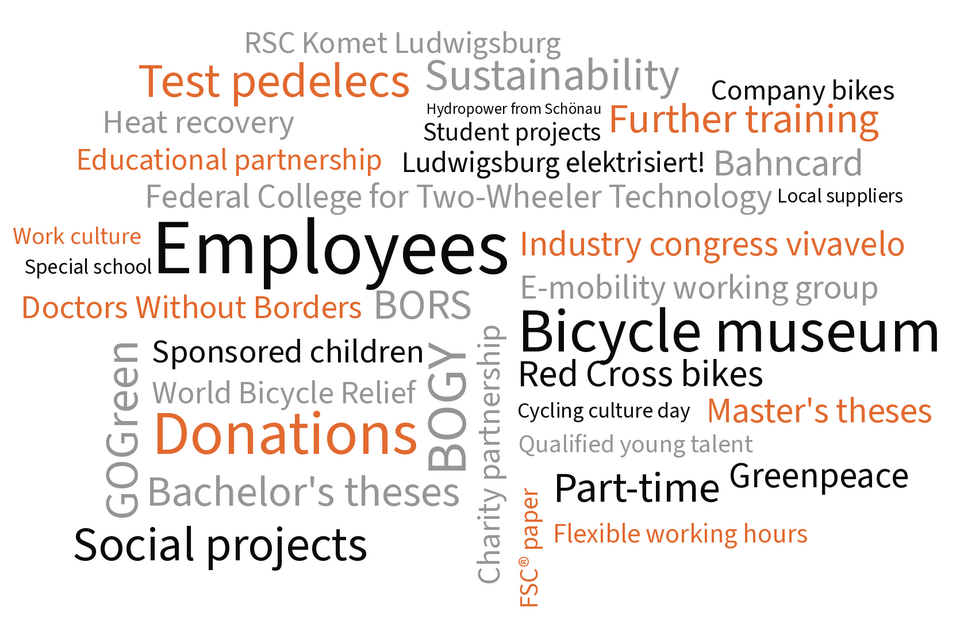
Our support work focuses on the wellbeing of our employees, the voluntary promotion of cycling, environmental protection, support for education and training at all levels, and our charitable commitment.
Show less
Climate-neutral operations – the Zedler-Institut provides transparency
The report clearly documents the regularly recorded data from the more than 80 measuring devices installed throughout the building. Meaningful charts and a large number of photos illustrate our ecological and economical operations.
The results, presented in an easy-to-understand way by our graphic designer, make it clear that the Zedler-Institut works in a climate-positive building. What’s more, with business operations that are climate-neutral overall, we are already meeting the EU’s climate targets for 2050.
As a result, this means for everyone who has products tested with us, for Technical Documentation customers and for clients who need an expert report that we are also a reliable partner in terms of CSR criteria when it comes to supply chain management.
You can find all sustainability reports since 2019/2020 in our archive.
The Zedler-Institut builds its success on a strong, motivated team. That is why we make sure our employees feel at ease: our collaboration is characterised by mutual respect and openness, every contribution is recognised and every personality is valued. Work and private life can be balanced exceptionally well with us. We offer flexible working time models and part-time work, especially for mothers, making it easier for them to return to working life.
Professional development
We support further training at specialist conferences and seminars and contribute to the costs. To preserve existing jobs and create new ones, we make our decisions with a long-term and economically sound perspective. This creates the conditions for long-term employee retention.
A good working atmosphere means a lot to us. That is why we invest in spacious workstations: quiet computers, each with two large low-radiation screens, many solid wood desks and plenty of plants throughout the entire work area.
Passion for cycling
We welcome it when our employees are also passionate about cycling in their private lives. They gain practical experience with the subject matter of their work and do something for their health. That is why we support everyone who cycles to work:
Test bicycles and pedelecs are available free of charge for the commute. In return, employees document their route, anything unusual, wear and, for pedelecs, every battery charge.
Maintenance: The bikes are regularly serviced in our in-house workshop so that they remain safe and comfortable.
Equipment: Helmets and locks are free to use, and next to the entrance there is a weather-protected parking area and a theft-proof bike park.
Showers and changing room: Clean showers and regularly washed towels, as well as drying rooms and lockers for cycling clothing and personal belongings.
Anyone who wants to test themselves in competition can also count on us: the Zedler-Institut covers the entry fees for various RTFs (cycle touring events) in the region, the Sachsenheimer Lichtenstern-Tour, the Barocklauf Ludwigsburg and the Dirty Race.
Exceptional athlete Julian Großkopf first came into contact with the Zedler-Institut during an internship lasting several months in 2018. From the beginning of 2021 until March 2024, Julian was a member of the Zedler team as a working student.
Since 2021, the Zedler-Institut has been committed to supporting the athlete with clothing, fast bikes and equipment for training and competition in triathlon and running.
Julian successfully completed his “Aerospace Engineering” degree at the University of Stuttgart with a Bachelor of Science in autumn 2024. He is currently deepening his knowledge in the follow-on master’s programme, which he expects to complete in spring 2028.
Since the 2025 season, he has held a professional licence from the German Triathlon Union (DTU).
Since 2025, he has once again been supporting the Zedler-Institut team part-time, taking care of quality assurance in the Zedler-Institut’s testing laboratory.
This support allows him to focus fully on his competitions as a professional. His athlete and sponsorship portfolio impressively illustrates his successes to date, personal bests and goals for the future.
We know how important solid training is. That is why we support young people and young adults on their way into the working world and are committed to developing qualified young talent for the industry, because a vocational apprenticeship raises the quality of work in the bicycle industry.
The Zedler-Institut was the first company in Baden-Württemberg to offer an apprenticeship for the profession of bicycle assembler. We further strengthen this low-threshold entry into the bicycle industry by having provided examiners for the responsible vocational training committee of the Stuttgart Region Chamber of Industry and Commerce (IHK) for many years, and we continue to support this under the umbrella of the Stuttgart Chamber of Crafts (HWK). Since 2014, we have also been training two-wheeler mechatronics technicians in our workshops. For this young apprenticeship trade, too, we were among the first in the state to offer a training place.
Educational partnership with three schools
To inspire pupils early on for careers in the bicycle industry and safe bicycle technology, we have had an educational partnership with three schools in Marbach am Neckar since March 2013. At our own expense, we set up a bicycle workshop on the school grounds. We also supervise pupils as part of the career orientation programmes at grammar schools (BOGY) and secondary schools (BORS), and regularly open our workshop, laboratory and bicycle museum to school classes.
Expert talks for industry professionals
We share our expertise gained over more than 30 years in expert talks, including at Eurobike, at the bicycle industry congress vivavelo which has continued as “twrds tmrrw” since 2026, and at events of the DVM (Deutscher Verband für Materialforschung und -prüfung e.V.). Students can write their final theses with us at any time, as numerous bachelor’s and master’s graduates as well as technicians and graduate engineers have already done.
We are not only professionally committed to environmentally friendly mobility, but also make the conditions of our work as sustainable as possible. In all its business activities, the Zedler-Institut ensures environmentally friendly and resource-efficient operations.
A core concern is long-lasting and repairable products. Since the beginning of his career as a bicycle expert, company founder Dirk Zedler has been explaining in specialist articles and television reports that cheap “disposable bikes” from big-box stores are worthwhile neither for your wallet nor for the environment.
Sparsamer Umgang mit Ressourcen
Besondere Aufmerksamkeit erhalten Rahmen und Komponenten aus Carbon: Ihre Herstellung verbraucht viel Energie, und der Kunststoff lässt sich kaum wiederverwerten.
Prüflabor: Die Analyse vor der Serienfertigung trägt dazu bei, dass weniger kurzlebige Produkte auf den Markt kommen.
Gebrauchte Teile: Unsere Prüfverfahren zeigen, ob sie nach einem Sturz beschädigt sind. So lässt sich unnötiger Ersatz vermeiden.
Reparatur: Dank unserer wissenschaftlich fundierten Nachweise können spezialisierte Unternehmen beschädigte Carbonrahmen haftungsrechtskonform reparieren. Das verlängert die Lebensdauer und spart Rohstoffe und Energie.
Ressourcenschonende Mobilität
For business trips, we use the train whenever possible: energy-saving, low in emissions, with less risk of traffic jams and less travel stress. Around three quarters of all business journeys are made by public transport or bicycle. Employees who come by bike benefit from a free fleet of bicycles and pedelecs, shower and changing rooms and covered parking spaces at the main entrance.
When it comes to business partners, we focus on short distances and give preference to local, environmentally conscious companies, for example a mechanical engineering company on the same street. We have our instruction manuals printed in the Stuttgart area on sustainably produced FSC® paper. This saves CO2 and strengthens businesses and jobs in the region. We accept higher costs for this, for example compared with suppliers in the Far East, whose working methods we cannot check for sustainability.
We offset transport and timber harvesting with Klimaprint®. As part of this, trees are planted in Germany to reforest cleared woodland areas. In this way, we support ecological forest projects. Since 2022, 7,414 trees have already been planted in Germany.
Energy-saving and low-emission working methods
At our headquarters, we use green electricity exclusively (i.e. entirely from plants that generate electricity from renewable energy sources) and use electricity and heat efficiently:
Waste heat: Generating compressed air for our test systems usually wastes 80% of the electricity as waste heat. With our sophisticated energy concept, from our own large photovoltaic system to efficiently controlled compressors with waste heat recovery, we use this for hot water, such as showers, washing machines and dishwashers, and for heating and cooling the building.
No air conditioning: Thanks to a ventilation plan (fresh air early in the morning), it stays pleasant even in summer.
We also save resources in our contact with customers: at least 95% of correspondence is handled electronically, internally we only use recycled paper printed on both sides, and for shipping we use second-hand cardboard boxes from a neighbouring bike shop wherever possible.
Helping to leave the world a little better: just as we are guided by environmental awareness as a company, we also support social projects beyond that, both as a company and as individuals, within our economic means.
That is why, for example, we do not give gifts, Christmas cards or the like to our customers and business partners. Instead, we regularly donate substantial amounts, many times the cost of such gifts, to charitable organisations such as Aktion Deutschland Hilft, Greenpeace, Doctors Without Borders, SOS Children’s Villages, UNICEF and WWF.
Partnerships
These donations are complemented by sponsorships for children in the Third World: since 2010, the Zedler-Institut has been supporting several sponsored children in India, Africa and South America.
Bicycles for Africa
Our core topic, the bicycle, also plays a key role in our social commitment: in Africa, bicycles enable many people to lead a better and freer life, as on average one bicycle there is used by five people.
As early as 2015, in cooperation with World Bicycle Relief (WBR), an aid organisation for Africa, we decided to donate €0.50 for every kilometre ridden by our employees, customers and business partners at the two cycle touring events (RTFs). This was continued in the following years and is still the case today.
In this way, we have now funded a good hundred bicycles for pupils and adults in disadvantaged regions of Africa. The donations have also been used to run workshops and buy spare parts.
The value of non-profit work can hardly be measured in figures. That is why the Zedler-Institut is committed to the bicycle and pedelec in many different ways, free of charge.
Committees and workshops
We promote the quality, user-friendliness and safety of bicycles, e-bikes and cargo bikes as well as the professionalism of manufacturers and retailers, and to this end we share our expertise on a voluntary basis:
DIN committee for bicycles: Dipl.-Ing. Dirk Zedler has been involved in the further development of technical standards since 1995.
DVM: We pass on our experience in materials research and testing and help shape workshops on bicycle technology.
Replacement parts catalogue: Together with VSF and ZIV, we have developed a guide to modifications on 25 km/h and 45 km/h pedelecs and to the risks of tuning and retrofitting. It clarifies which components may be replaced freely and which only with the manufacturer’s approval, for reasons of liability law.
Magazines and media
We support magazines, independent TV productions and podcasts so that consumers receive factually correct information. In total, Dirk Zedler has appeared more than 100 times as a bicycle expert on television and as a guest on numerous podcasts. His contributions to print publications and online articles number in the several hundreds.
Associations and politics
VSF: As a member, we support the association with specialist training (e.g. the VSF Academy, and formerly the Career Center at Eurobike) and individual advice for members.
Zukunft Fahrrad e.V.: Dirk Zedler is deputy chairman and is committed to bicycle safety on the board and among the members.
Förderkreis Wirtschaft, Politik & Gesellschaft der AGFK-BW: We are a founding member. Together with the AGFK-BW and the Baden-Württemberg Ministry of Transport, the Förderkreis initiates a dialogue about the future of mobility.
Expert talks and vocational training
We strengthen the industry’s expertise with independent talks, e.g. on pedelec technology, liability pitfalls, lightweight construction, carbon damage and CE marking. These often take place free of charge or at reduced rates so that as many professionals as possible can take part.
At the Stuttgart Region Chamber of Industry and Commerce (IHK), Dirk Zedler is involved in vocational training on a voluntary basis: he played a key role in introducing the apprenticeship trade of bicycle assembler and worked on the examination board for many years without pay.
Historic bicycle collection
Since the 1990s, Dirk Zedler and bicycle enthusiast Helge Schultz have been building up one of the largest collections of historic bicycles in Europe. More than 300 exhibits, from the Drais running machine of around 1820 to a victorious professional road bike from 2021, bring more than two centuries of bicycle technology to life and are shown during guided tours, events and special exhibitions.